
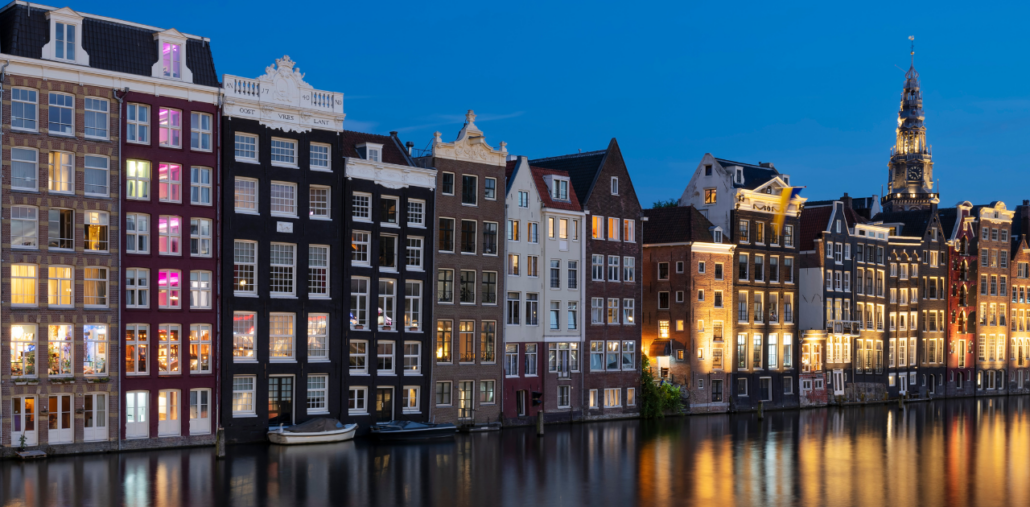
Amsterdam and cannabis: shaping the urban imaginary
Amsterdam did not become Europe’s symbol of cannabis simply because of its laws. It earned that status because, earlier and more effectively than other cities, it turned cannabis into a visible urban fact: a habit, an aesthetic, a narrative, almost a stage set.
For decades, in the European collective imagination, Amsterdam came to represent a different way of accessing cannabis: less clandestine, less peripheral, less pushed into invisibility. Not necessarily free in any absolute sense, but recognisable, situated, woven into the fabric of the city. Coffeeshops played a decisive role in this process, but on their own they are not enough to explain the phenomenon. What makes Amsterdam unique is the way cannabis settled into the urban landscape and popular culture: in shop signs, window displays, souvenirs, travel stories, and the visual memory of generations of visitors.
This is where Amsterdam established its primacy. Not so much as a permissive city, but as a city capable of giving cannabis a stable urban form and, for that very reason, one that could be exported into the European imagination.
Cannabis as part of the city’s image
In many cities, cannabis remains a private, underground or marginal matter. In Amsterdam, by contrast, it became a visible presence. That is the first crucial point. The city did not simply host a form of consumption; it placed it within a precise, recognisable and legible geography.
Here, cannabis belongs not only to the act of consumption itself. It belongs to the way the city is perceived. It forms part of its reputation, its visual language, its tourist memory. It is one of those cases in which a substance stops being merely an object and becomes an urban sign. What matters is not only what is consumed, but where, how, and within what symbolic setting.
Amsterdam built that setting with extraordinary force. It made cannabis something you encountered before you ever tried it: in the stories of those who had been there, in images, in expectations, in that kind of cultural familiarity that emerges when a city manages to attach a phenomenon to a landscape.
The coffeeshop as urban space and cultural ritual
The coffeeshop is the material centre of this imaginary, but reducing it to a point of sale would be a mistake. Above all, the coffeeshop was an urban space with a specific cultural function. It took cannabis out of the purely clandestine sphere and placed it in a defined setting, with its own rules, codes, rituals and visual grammar.
This is where cannabis changes status. It is no longer simply transgression or informal consumption; it becomes a situated experience. The coffeeshop produces atmosphere before it produces commerce. It creates a way of being, of entering, of observing, of inhabiting for an hour a space that is recognisable and unlike the rest.
This also had a huge symbolic impact. Wherever a stable place exists, a scene exists too. And wherever a scene exists, a shared image begins to form. That is what the coffeeshop became: an urban interior that gave shape to a visible culture, somewhere between social ritual and a mechanism of normalisation.
Amsterdam and the Making of a European Pop Icon
What made Amsterdam so influential was not only its local specificity, but its ability to turn itself into an exportable imaginary. The city produced a genuine cannabis iconography: signs, stylised leaves, neon lights, venue names, gadgets, mental maps, photographs, travel stories. Over time, all this built up a visual archive that anyone could recognise.
This is where pop culture comes in. Amsterdam did not merely normalise the urban presence of cannabis; it also made it narratable, photographable, memorable. Cannabis entered the aesthetics of European youth tourism, the mythology of travel, Interrail stories, and the memory of those seeking in the city an experience different from what was possible elsewhere.
In this sense, Amsterdam did for cannabis something few cities manage to do for a social phenomenon: it turned it into a culturally autonomous image. No longer just a substance, but a sign. No longer just a regulatory issue, but an atmosphere. And when an urban sign works this well, it stops belonging only to the city and begins to live beyond it, in visual culture and popular language.
When the imaginary outgrows the law
The paradox of Amsterdam is that its image became far simpler than the system that produced it. From the outside, the city was often read as the capital of absolute freedom, as a place where cannabis was simply “legal”. But the real model has always been more ambiguous.
The core of the Dutch system is not full legalisation, but regulated tolerance, historically built on the distinction between soft and hard drugs and on the desire to keep the two markets separate. This means that Amsterdam’s urban myth rests on a framework that is far more cautious and administratively managed than its reputation suggests.
And this is precisely where the case becomes interesting. The city generated an imaginary of radical openness from a system built instead on compromises, limits and selective management. Put simply: symbolic Amsterdam has always been larger than legal Amsterdam. And that distance between image and rule is an essential part of its cultural appeal.
The less romantic side of the myth: containment and contradictions
All strong urban imaginaries produce side effects too. In Amsterdam’s case, cannabis generated not only fascination, but also tourism pressure, symbolic congestion, simplifications, and the need to govern a sector that had become larger than its original narrative.
For that reason, the model cannot be told only as an aesthetic or cultural success story. Over time, the city had to contain, regulate, reduce, and bring the phenomenon back within administratively manageable limits. Then there is the issue that matters most to those who really follow the sector: the fact that the visibility of the coffeeshop was not, for years, matched by a fully coherent supply chain. The system became far better at staging cannabis than at resolving all of its structural contradictions.
That, too, is why Amsterdam remains relevant. Not because it represents a perfect model, but because it shows with great clarity the point at which urban culture, commerce, governance and myth begin to pull against one another.
Why Amsterdam still matters today
Amsterdam still matters because it was the first major European city to make cannabis a recognisable part of its urban image. Not the only one, and not necessarily the most advanced today in regulatory terms, but the first to build a lasting symbolic landscape around it.
That is why, even now, speaking about cannabis in Europe almost always means passing through Amsterdam in one way or another. Not only because of the laws, but because it was there that cannabis finally ceased to be a form of marginality and became part of the urban stage.
If you want to know more about the other cities of cannabis, check out this blog post

