
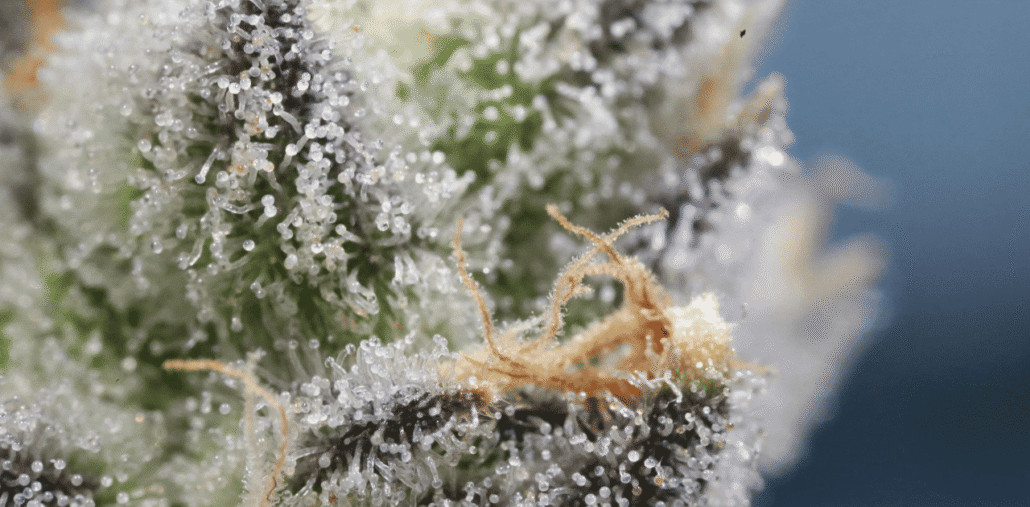
Trichomes: the reason why cannabis buds are sticky
If you have ever found your fingers sticking together after handling a high-quality cannabis flower, you know exactly what we are talking about. That distinctive texture and shiny, almost “frosted” appearance are mainly due to resin. This is where most cannabinoids, terpenes and all the aromatic compounds that make each strain unique are found. Simply saying “it’s the resin,” however, only tells half the story. To understand where all this magic really comes from, we need to zoom in on microscopic structures measuring just a fraction of a millimetre: glandular trichomes.
Not all trichomes are the same
Trichomes are tiny outgrowths found on the epidermis of many different plants. They come in different shapes and perform different functions: some look like simple hairs, while others are genuine miniature chemical factories.
In cannabis, the traditional classification identifies three types of glandular trichomes:
- Bulbous: extremely small and barely raised above the surface.
- Capitate-sessile: with a spherical head and an almost invisible stalk.
- Capitate-stalked: the ones we are all familiar with, featuring a slender stalk and a well-developed head.
This distinction, however, is becoming less clear-cut. Recent studies suggest that many trichomes that appear “sessile” on young flowers may actually be capitate-stalked trichomes at an early stage of development.
The difference can also be seen in the numbers: when analysing the disc of secretory cells at the base of the head, sessile trichomes on the leaves generally have eight, while stalked trichomes on mature flowers may have between 12 and 16. In other words, what we see on the plant’s surface evolves day by day as the plant matures.
But how is resin actually produced?
The head of a stalked trichome is a genuine biological laboratory. At its base is a disc of highly active secretory cells busy producing cannabinoids, terpenes and other metabolites.
Biosynthesis is a complex process involving different areas of the cell, including the cytoplasm, plastids and the space outside the cell membrane. The newly synthesised compounds are then deposited in a cavity between the secretory cells and the outer cuticle. As resin continues to accumulate, this chamber expands until it forms the distinctive rounded head visible under a microscope.
Recent genetic and metabolic profiling studies confirm that stalked trichomes on the bracts of female flowers are the primary site for the production and storage of these substances.
CBDA and THCA: the plant produces acids
One essential detail is that the main cannabinoids in the fresh plant are not present in their “active” form, but in their acidic form.
- CBD-dominant varieties mainly produce CBDA
- THC-dominant varieties accumulate THCA
The neutral forms—CBD and THC—are only produced later through decarboxylation, a process triggered by heat and influenced by light, time and storage conditions. It is therefore inaccurate to imagine trichomes as reservoirs already containing the final product listed on the label: the chemical composition changes during drying, processing and storage.
The same applies to terpenes. Because they are volatile compounds, they are extremely sensitive to temperature fluctuations, oxygen, light and handling.
Why does the plant invest so much energy in trichomes?
Creating such complex structures and hundreds of different compounds requires an enormous amount of energy. So why does cannabis do it?
Although not all their functions have been fully understood, the most widely accepted theory is defence: the resin’s viscosity acts as a sticky trap for small insects, while specific terpenes and cannabinoids work as natural repellents. Other hypotheses link trichomes to protection against UV radiation and microorganisms.
As highlighted by several scientific reviews, including the one by Tanney and colleagues, more cannabis-specific research is still needed, since many of these explanations are derived from studies of other species. The most realistic answer is that resin performs several functions at once, potentially protecting the plant itself from the internal accumulation of the metabolites it produces.
How trichomes evolve as the plant matures
As the weeks pass, trichomes change in both appearance and chemical profile.
Research published in The Plant Journal shows that trichomes on mature flowers become highly specialised in the production of cannabinoids and monoterpenes compared with those found on vegetative leaves.
The colour of the trichome head also changes: from clear to cloudy, eventually developing amber or brown hues. Growers have long used these changes as a guide for deciding when to harvest, although colour is not an exact measure of cannabinoid concentration, as every genetic variety has its own timings and characteristics. Colour provides an indication, but only laboratory testing can offer chemical certainty.
Handle with care: trichome are fragile
Trichome heads are extremely delicate spheres. Rough friction, aggressive trimming, careless transport and improper storage can break them or detach them permanently.
Studies on post-harvest processing confirm that mechanically trimmed samples—processed using industrial machinery—contain significantly more damaged or headless trichomes than flowers carefully trimmed by hand.
This is why final quality depends on every stage of the process. A plant may produce an exceptional amount of resin, but if the supply chain fails to handle it properly, much of that valuable material will be lost.
Is a sticky bud always a sign of quality?
The short answer is: not necessarily.
Stickiness is a strong indication of abundant resin, but on its own it does not guarantee a very high percentage of CBD, nor does it ensure that the flower is free from mould, pesticides or heavy metals. A flower that has been dried poorly or contains too much moisture may also feel deceptively sticky: moisture and resin content are not the same thing.
Appearance, texture and aroma are valuable clues to the experienced eye, but only laboratory testing can provide certainty about purity and cannabinoid profile. And this is precisely how a simple question—“why are cannabis buds sticky?”—turns into a fascinating journey through science, nature and respect for the plant.
